

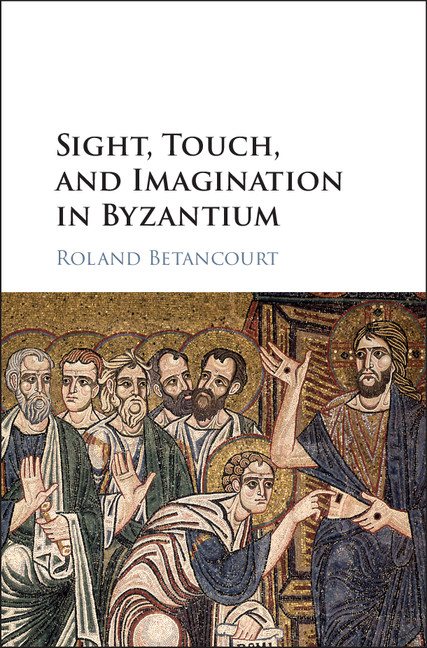
Sight, Touch, and Imagination in Byzantium
- ICMA–Kress Grant for First Book Publication
A history of how Byzantine writers understood seeing, touching, and imagining. Surveying classical, late antique, and medieval theories of vision, the book argues that the tactile language Byzantines used for sight described the mind’s grasp of what the senses delivered, and shows what that theory of perception meant for the making and viewing of images, and for the image as a site of desire for the Divine.
From the publisher
Considering the interrelations between sight, touch, and imagination, this book surveys classical, late antique, and medieval theories of vision to elaborate on how various spheres of the Byzantine world categorized and comprehended sensation and perception. Revisiting scholarly assumptions about the tactility of sight in the Byzantine world, it demonstrates how the haptic language associated with vision referred to the cognitive actions of the viewer as they grasped sensory data in the mind in order to comprehend and produce working imaginations of objects for thought and memory. At stake is how the affordances and limitations of the senses came to delineate and cultivate the manner in which art and rhetoric was understood as mediating the realities they wished to convey. This would similarly come to contour how Byzantine religious culture could also go about accessing the sacred, the image serving as a site of desire for the mediated representation of the Divine.
Description courtesy of Cambridge University Press.
Praise
The range of texts and their careful translation and interpretation command admiration and respect.... In Betancourt’s detailed examination, their medieval theories of Sight, Touch and Imagination are given brilliant exposition.
Judith Herrin, Journal of Ecclesiastical HistoryBetancourt also presents an interesting defence of the methodology used throughout, which is, I believe, one of the book’s strongest points.... The wealth of material it collects will allow scholars to deepen and enrich the study of Byzantine theories of vision.
Roberto Zambiasi, Mediterranea: International Journal on the Transfer of Knowledge全編にわたって膨大な量のテクストの具体的かつ詳細な解釈がなされる本書……総論としての限りでは極めて整合的な読み筋が展開される。
Shigeki Tsuchihashi (土橋茂樹), Studies in Medieval Thought (中世思想研究) · In translation: A book that offers concrete and detailed interpretations of a vast body of texts from beginning to end… as a whole, it develops a highly coherent line of reading.
Endorsements
This is a very learned and important book, with significant ramifications for thinking about sight and touch, aesthetics, the cultural history of vision, the historiography of Byzantine art and continuity/shift between the classical world and Byzantium. Betancourt shows better than all previous scholarship how theories of vision/touch grow out of their classical intellectual archaeology.
Jaś Elsner, Humphrey Payne Senior Research Fellow in Classical Art, Corpus Christi College, University of Oxford
Reviews
| Venue | Reviewer | Date | Link |
|---|---|---|---|
| Journal of Ecclesiastical History75:1 (2024): 158–161 | Judith Herrin | January 2024 | DOI |
| Mediterranea: International Journal on the Transfer of Knowledge“A New Season for the Study of Byzantine Theories of Vision,” 8 (2023): 509–539 | Roberto Zambiasi | 2023 | Read |
| Studies in Medieval Thought (中世思想研究)63 (2021): 104–110 (in Japanese) | Shigeki Tsuchihashi (土橋茂樹) | 2021 |